
Written by Harshal Rathod | Updated: October 2026
An air fryer can make everyday snacks lighter and quicker, but only if you buy the right size for the way your family actually eats. This guide explains how to choose an air fryer in India by use, capacity, wattage, cleaning and service, so you can judge any model yourself, not just follow a list.
Start with one honest expectation. An air fryer is not a deep fryer without oil. It cooks with fast, hot air, so food can turn crisp with a light brush or spray of oil, but it will not taste exactly like food fried in a kadhai full of oil, and it will not cook a large family meal in one small basket. If that trade-off suits you, it is a useful appliance. If you mainly cook large, wet-battered dishes for many people at once, it may disappoint you no matter which brand you buy.
How an air fryer actually cooks
An air fryer has a heating element and a fan that moves very hot air around the food. The food needs space for that air to move. In a single layer, with a little space between pieces, samosas, pakoras, fries, paneer tikka and roasted vegetables can crisp well. Piled on top of each other, the same food steams in the middle and crisps only on top.
Three habits matter more than any preset button. First, preheat for a few minutes, as your model’s manual says, so the basket is hot when food goes in. Second, shake the basket or turn the food halfway through, especially for fries and pakoras. Third, do not overfill the basket. Cooking in two smaller batches usually gives better food than one overloaded batch, even though it takes longer.
An air fryer is also not a replacement for every appliance. It can fry, roast, bake and reheat in small quantities, but it is not an oven for a large cake, not a tandoor, and not a good choice for very wet batters that drip through the basket. Check your model’s manual for what it allows, because basket design and coating differ by model.
Start with how you will actually use it
Before you look at brands, answer three questions about your own kitchen.
First, what will you cook most often? Snacks such as samosas, cutlets and fries need a flat, wide basket and good airflow. Paneer tikka and chicken tikka need space so pieces do not stick together. Baking a small cake or muffins needs a basket that can hold a suitable tin, if your model’s manual allows it. Reheating leftovers needs only a small basket and a low, gentle setting.
Second, how many people will you cook for at one time? A basket that is right for two people will mean two or three batches for a family of five, and by the time the last batch is ready, the first batch is cold. A very large basket, on the other hand, takes more counter space, more power, and more cleaning for a single person who only makes a small snack.
Third, how much counter and storage space do you have? Measure the height under your kitchen cabinets as well as the width, because an air fryer is tall, and you need space above it for hot air to escape. A model that does not fit comfortably will be pushed to the back of a cupboard and will not be used.
Capacity: headline litres are not food
This is the most common confusion in air fryer shopping. The litre figure on the box is usually the pan capacity, not the amount of food you can cook in one layer. A 4.2 litre pan does not mean you can cook 4.2 litres of samosas at once. The usable space is the basket, and it is smaller once you leave room for air to move.
Use capacity as a rough guide, then check the basket shape and your own batch size:
- For one or two people, or for snacks only, a 3 to 4 litre pan is usually enough.
- For a family of three or four, a 4 to 5 litre pan is the usual middle ground, with one batch for most snacks and two batches for a full meal.
- For five or more people, or for cooking a full meal in one go, look at 5.5 litres and above, or consider an oven-style air fryer, which is a different category with shelves instead of a single basket. Do not assume a larger basket alone solves the problem, because a larger basket also needs more wattage and more counter space.
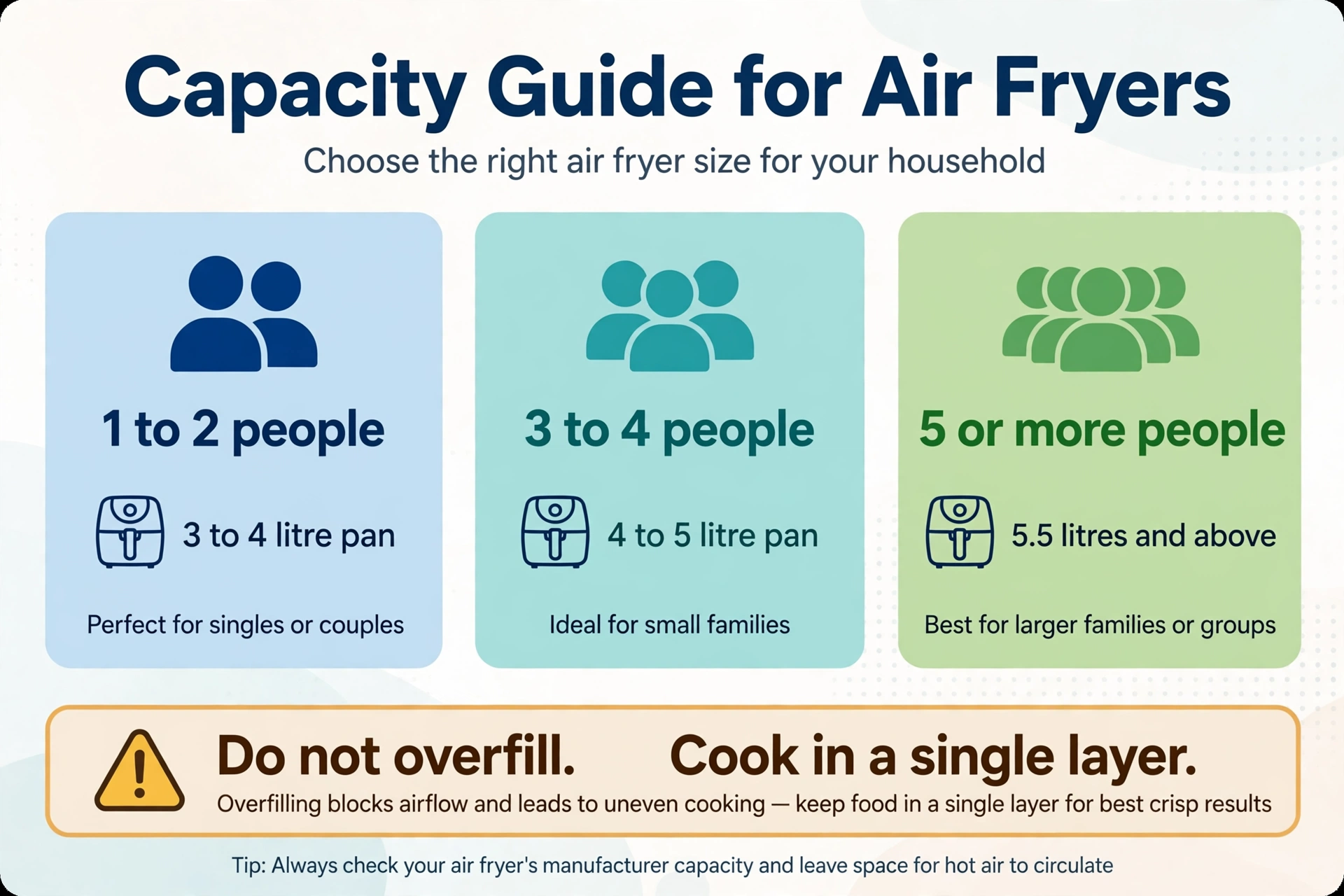
If possible, think in pieces, not litres. How many samosas, or how many chicken pieces, do you want in one batch? That question will tell you more than the headline number. And always follow your model’s manual on maximum fill, because overfilling is the fastest way to get uneven, soggy food.
Wattage and temperature: power helps, but it is not everything
Wattage tells you how much power the heating element can use. Higher wattage usually means faster heating and faster recovery when you open the basket, but it does not automatically mean better food. A well-designed basket with good airflow at 1400 watts can cook better than a poorly designed basket at higher wattage, and a very high wattage model will also use more electricity per minute.
For most Indian homes, these ranges are a useful starting point:
- Around 1200 watts is workable for small to medium baskets and small batches, but it may be slower, especially for a full basket, depending on basket design and batch size.
- Around 1400 to 1500 watts is the usual middle ground for 4 to 5 litre basket models, and it suits most family snack cooking.
- Around 1600 watts and above is more useful for larger baskets, where more air and more heat are needed to crisp a full load.
Temperature range matters too. Most basket models in this guide run from about 80°C to 200°C. The low end is useful for reheating and for gentle cooking, the middle range suits most snacks, and the high end is for crisping. A preset button does not change the physics: if the temperature is too low, food will dry out before it crisps, and if it is too high, the outside will brown while the inside stays raw. Start with your model’s manual and a small test batch, then adjust by a few degrees for your own recipes.
On running cost, a rough guide is enough. A 1500 watt model running for 20 minutes uses about 0.5 units of electricity, because 1.5 kilowatts multiplied by one third of an hour is 0.5 kilowatt-hours. Your actual bill depends on your tariff and on how often you use it, but an air fryer used for snacks a few times a week is not, by itself, a large electricity cost. It is cheaper in energy than heating a full conventional oven for a small snack, because it heats a much smaller space.
Controls and presets: useful starting points, not recipes
You will see two main types of controls. Knob controls are simple to operate, and easy for older family members to understand. Always operate the controls with dry hands, as Philips safety instructions advise. Touch panels look modern, often come with a digital display, and may include a cooking window so you can see the food without opening the basket. Neither type is automatically better. A touch panel that is hard to read in bright kitchen light, or that resets when you touch it by mistake, is worse than a simple knob you can set without looking.
Presets are also starting points, not guarantees. A preset for fries, chicken, cake or samosa sets a time and temperature that the maker thinks suits a typical batch. Your batch size, the thickness of your pieces, and whether the food is fresh or frozen will change the result. A preset is useful if you can adjust it, and less useful if it locks you into one setting.
One preset worth noting for Indian cooking is a samosa preset, which some Indian brands include. It does not make a samosa cook itself, but it shows that the maker has thought about Indian snacks, not just fries. Judge a preset by whether you can change its time and temperature, not by how many presets are printed on the panel.
Cleaning and coating: the part you will live with every day
Cleaning decides whether an air fryer stays in daily use or ends up in a cupboard. After cooking, the basket and pan will have oil, crumbs and, for some foods, stuck-on coating. A non-stick basket helps, but it is not magic, and it needs care. Do not use metal tools on a non-stick surface if your manual says not to, do not soak a basket that your manual says should only be wiped, and let the basket cool before washing it.
Dishwasher safety is a real difference between models, and it is easy to get wrong. Some models list the basket as dishwasher safe, while others say the pan and separator should be hand washed, even if the outer body looks similar. Do not assume. Check your exact model’s manual before you put any part in a dishwasher, because a damaged coating will make every later meal stick and taste worse.
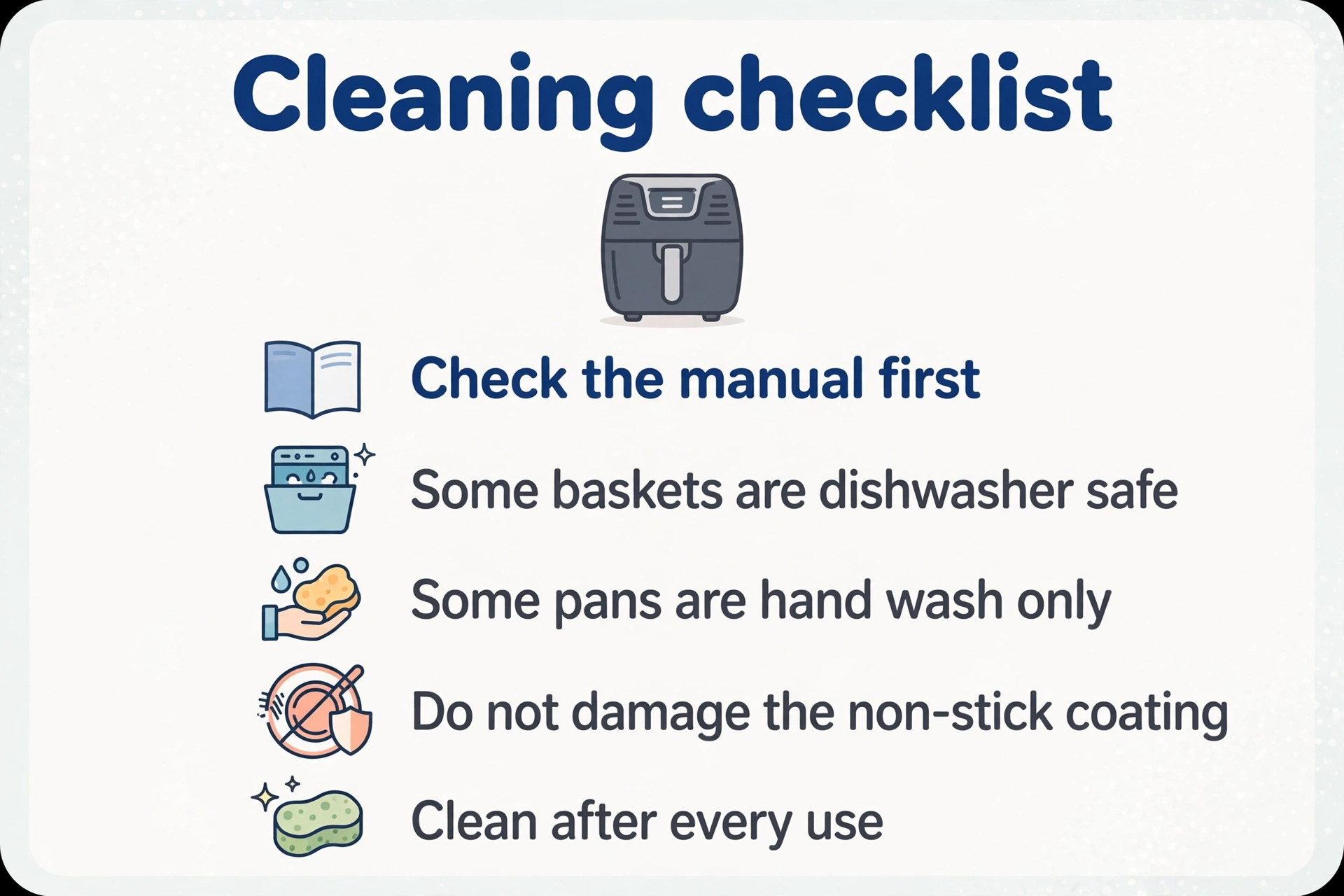
Also check the heating element and the inside of the lid, if your model allows access. Grease that builds up there can smoke on the next use. A model with a removable basket, a smooth pan, and clear cleaning instructions in its manual will be easier to live with than a model with a complicated basket that traps food in corners. If you cook oily foods often, this section of the manual matters as much as wattage.
Service, warranty and total cost
An air fryer is a heating appliance, and heating appliances sometimes need service. Before you buy, check three things that are easy to miss in a listing.
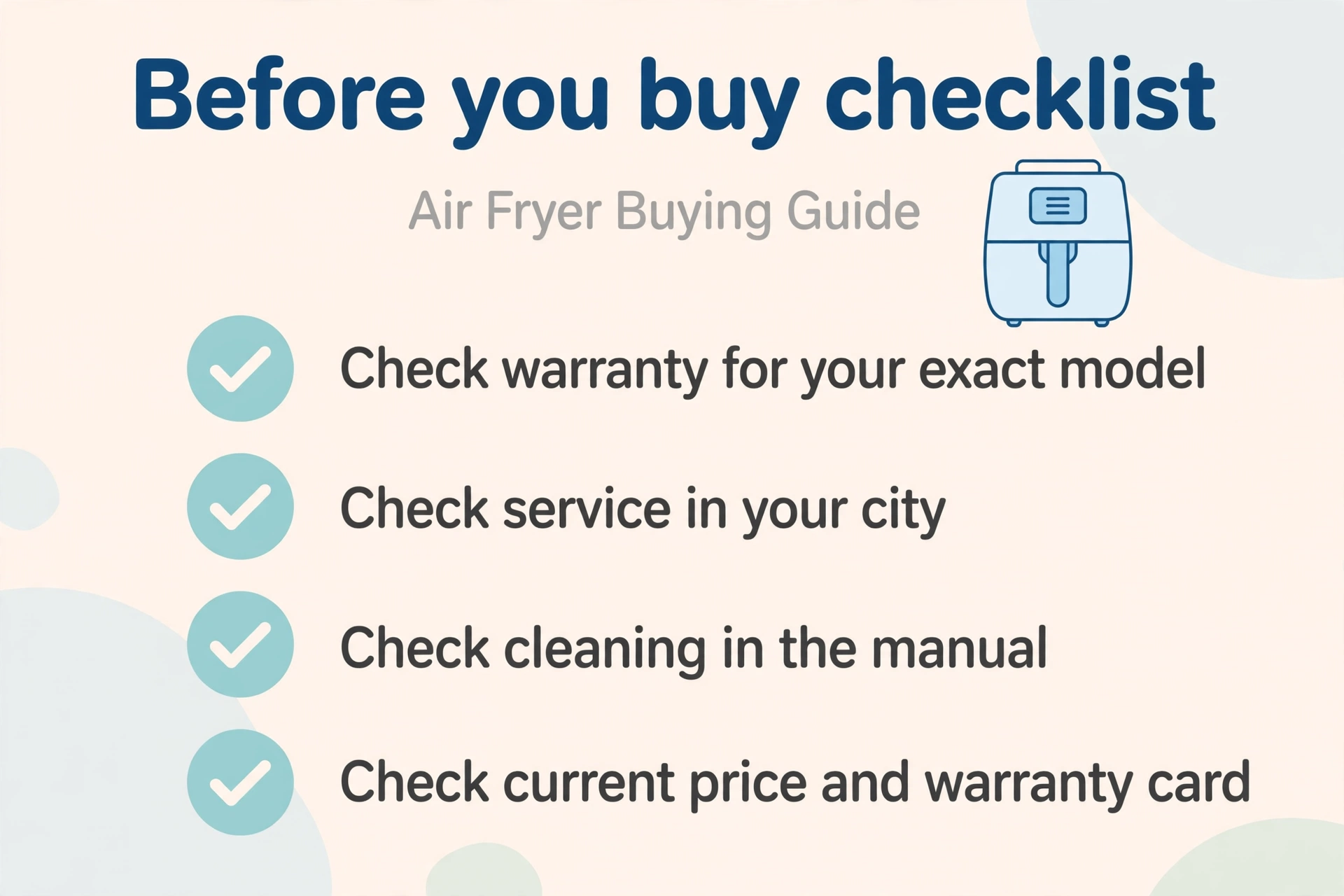
First, warranty length and what it covers. In the models below, Philips listings show a 2 year warranty, while the Prestige manual and Inalsa listings show a 1 year warranty for the models named. Warranty terms differ by variant, so check the warranty card for the exact model you are buying, not just the brand name. A longer warranty is useful, but only if service is available where you live.
Second, service in your city or town. A brand with a service centre near you, and with spare baskets or heating elements available, is worth more than a slightly cheaper model with no local service. Ask the seller or the brand’s customer care about service before you buy, especially if you live outside a large city.
Third, total cost, not just the purchase price. A cheaper model with a short warranty, a basket that needs replacing, and no local service can cost more over three years than a slightly dearer model that lasts. Prices change often, so this guide does not quote a live price. Check the current price, warranty card and service terms for the exact variant before you pay.
Three models that show how the checklist works
This section is not a ranking, and it is not based on lab testing by BuyinBest. The specifications below are as stated by the makers and in their manuals and listings, and they are included only to show how to read a specification sheet. Check the current official page and manual for the model you are considering before buying, because specifications and warranty terms change.
| Model, as listed | What it shows | What to check for your home |
|---|---|---|
| Philips Airfryer NA120/00, listings: 4.2 litre pan, 1500 watts, knob controls, Rapid Air technology, temperature up to 200°C, basket listed as dishwasher safe, 2 year warranty as listed | A simple, higher-wattage basket model for a family of three or four, with no touch panel to learn | Is a knob easier for your family than a touch panel? Is 4.2 litres enough for one batch of your usual snacks? Is service available in your city? |
| Inalsa Tasty Fry DW 4.2 (manual copy, not the official Inalsa site), manual and listings: 4.2 litre pan, 1400 watts, touch controls, 8 presets, visible cooking window, temperature 80°C to 200°C, manual copy gives hand-washing instructions for the pan and separator with hot water, dish soap and a non-abrasive sponge; do not assume dishwasher safe, 1 year warranty as listed | A touch-panel model with a window, useful for a beginner who wants to watch food without opening the basket and losing heat | Does the window matter to you, or will you shake the basket anyway? Are you happy to hand wash the pan? Is 1 year warranty enough for you? |
| Prestige Nutrifry Digital 41411, official Prestige shop and manual: 4.5 litre pan, 1200 watts, touch controls, 8 presets including Samosa, Pizza, Chicken, Cake and Veggies, temperature 80°C to 200°C, basket listed as not dishwasher safe, 1 year warranty in the manual | A familiar Indian brand with a samosa preset, but the lowest wattage of the three, so it may suit small batches better than a full, fast family meal; this was not tested, so check your batch size and the model’s manual | Does the samosa preset help you, or do you adjust time and temperature yourself? Will 1200 watts be too slow for a full basket? Are you happy to hand wash? |
Why these three, and why not others you may recognise? They show three different trade-offs, not three versions of the same model: simple knob and higher power, touch panel with a window, and a familiar brand with an Indian preset but lower power. That is the point of the section. If you prefer a touch panel from Philips, the HD9252/90 is in the same 4.1 litre class as the NA120/00, with 1400 watts and 7 presets, but it does not change the capacity or cooking outcome, so it does not add a new lesson to this checklist. If you need a much larger family size, an oven-style model is a different category and should be judged separately, not by basket litres alone.
The research lesson here is also why recognisability alone was not the test. Prestige is a familiar brand, yet its Nutrifry model has the lowest wattage of the three and a hand-wash basket, so it is not automatically the best choice for a large family, even though many buyers will have seen it before. A familiar name that fails on wattage, cleaning or warranty for your use should not be chosen just because it is familiar.
Pros and cons, in brief
Philips NA120/00: higher wattage and a simple knob, with a longer listed warranty. The trade-off is no cooking window and no touch display, so you judge doneness by time and by opening the basket.
Inalsa Tasty Fry DW 4.2: window and presets help a beginner, and the touch panel is easy to read. The trade-off is hand washing the pan and a shorter listed warranty than the Philips model above.
Prestige Nutrifry Digital 41411: samosa and other Indian presets, a familiar brand, and a 4.5 litre basket. The trade-off is lower wattage for that size, so large batches may take longer, though this was not tested, and the basket is hand wash only.
Common mistakes to avoid
- Buying the biggest basket without checking your counter space, or buying the smallest basket and then cooking every meal in three batches.
- Overfilling the basket so food steams instead of crisping. A single layer, with space for air, matters more than a higher temperature.
- Using a preset as a recipe. Presets are starting points. Check the food, shake the basket, and adjust time and temperature for your batch.
- Putting a basket in the dishwasher when your model’s manual says hand wash only. That can damage the coating and make later cooking worse.
- Judging a model by headline litres alone, without checking basket shape, wattage, cleaning and warranty for that exact variant.
- Assuming an air fryer will make every fried food taste like deep-fried food. It makes a lighter, crisper version, which suits many snacks, but it is not the same cooking method.
Final checklist before you buy
- Count your usual batch, not just your family size. How many pieces do you want in one batch?
- Measure your counter and cabinet height, and check the model’s dimensions for that exact variant.
- Match wattage to basket size. Around 1400 to 1500 watts suits most 4 to 5 litre baskets. Around 1200 watts may be slower for a full basket, depending on basket design and batch size.
- Check cleaning in the manual. Is the basket dishwasher safe for your exact model, or hand wash only?
- Check warranty length, what it covers, and whether service is available in your city.
- Check that presets can be adjusted, and that temperature and time controls are easy for the person who will cook most often.
- Check the current price, warranty card and manual for the exact variant before you pay, because listings change.
If you follow that order, you will buy an air fryer for your kitchen and your cooking, not for a headline number or a familiar name alone.
Related guide: How to Choose a Mixer Grinder in India
Frequently asked questions
Is air fryer food really oil free?
No, not in practice. Most air fryer recipes use a light brush or spray of oil for crispness, and some foods release their own fat. The point is much less oil than deep frying, not zero oil, and the exact amount depends on the food and the recipe.
Can I cook samosas and pakoras in an air fryer?
Yes, for small batches, if you brush them lightly with oil, keep them in a single layer, and shake or turn them halfway. Very wet batters can drip and stick, so follow your model’s manual and test a small batch first.
Is a bigger air fryer always better?
No. A bigger basket needs more counter space, more wattage, and more cleaning. It is better only if you regularly cook large batches in one go. For one or two people, a smaller basket will heat faster and be easier to clean.
Will a higher wattage model increase my electricity bill a lot?
Not by itself for snack use. A 1500 watt model running for 20 minutes uses about 0.5 units of electricity. How often you use it, and for how long, matters more than wattage alone. Check your tariff for the exact cost.
Can I put the basket in the dishwasher?
Only if your exact model’s manual says so. Some models list the basket as dishwasher safe, while the Prestige model above lists the pan as hand wash only, and the Inalsa manual copy gives hand-washing instructions for its pan and separator. Do not guess, because a damaged coating affects every later meal.
Do presets guarantee good results?
No. Presets set a starting time and temperature. Your batch size, food thickness, and whether food is fresh or frozen will change the result. Use a preset as a starting point, then adjust it for your own cooking.
About the author
This guide was written by Harshal Rathod, who runs BuyinBest.com. The aim is to help Indian households choose an air fryer by their own cooking and family size, not by marketing claims. If you need help with a specific model, or you spot an error in this guide, you can reach us through the Contact Us page. For how this site handles privacy, see the Privacy Policy.