
Written by Harshal Rathod | Updated: October 2026
Choosing a water purifier in India is not about buying the model with the most stages. It is about matching the purification method to the water that actually comes into your home. A purifier that is right for low-TDS municipal water can be the wrong choice for high-TDS borewell water, and the other way round.
Start with two facts about your own home: where your water comes from, and what its TDS is. TDS alone does not identify contaminants, so treatment choice also depends on the contaminants present and what a specific system can remove, which is why a lab test matters for doubtful sources. Those two facts decide most of the rest.
First, test your water before you buy
TDS stands for total dissolved solids. It is a measure of dissolved salts and minerals in water, usually shown in mg/L, which is the same as ppm for this purpose. A small handheld TDS meter can give a rough reading at home, but it is a screening tool, not a lab test. It tells you about dissolved solids, not about bacteria, viruses, arsenic, fluoride, or nitrate on its own.
The Bureau of Indian Standards, in IS 10500, sets an acceptable limit for TDS in drinking water at 500 mg/L, with a permissible limit of 2000 mg/L only when no alternative source is available. See also: Jal Jeevan Mission water quality framework. That permissible limit is not a target to aim for. It is a relaxation for places with no better source.
Use TDS as a first guide, in this way:
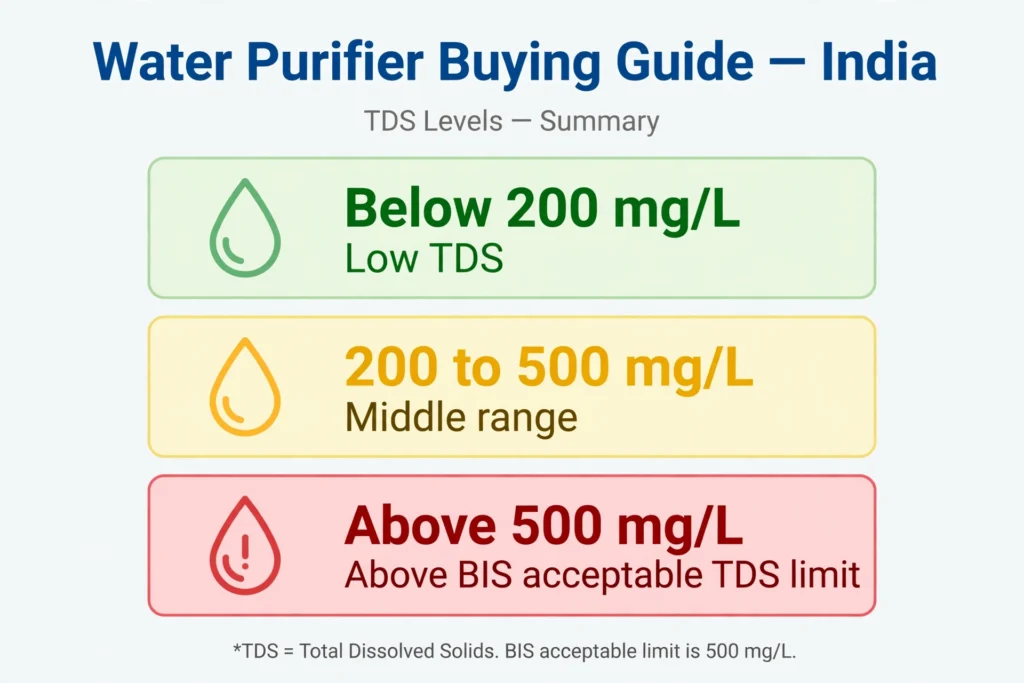
- Below about 200 mg/L: water is usually low in TDS. The main job is often disinfection and removing particles and taste, not lowering TDS.
- About 200 to 500 mg/L: this is a middle range. Taste and your source matter more here, and hardness matters only if it has been tested separately, because TDS alone does not measure hardness. A lab test or a check with your supplier helps if you are unsure.
- Above 500 mg/L: water exceeds the BIS acceptable limit for TDS. Dissolved solids are now a real issue, and RO becomes the usual route, because UV and UF do not lower TDS.
If your water looks cloudy, smells unusual, or comes from a source you do not trust, do not rely on a TDS meter alone. Get a lab test for the contaminants that matter in your area, and ask the purifier maker whether its model is rated for your input water.
RO, UV and UF: what each one actually does
Reverse osmosis
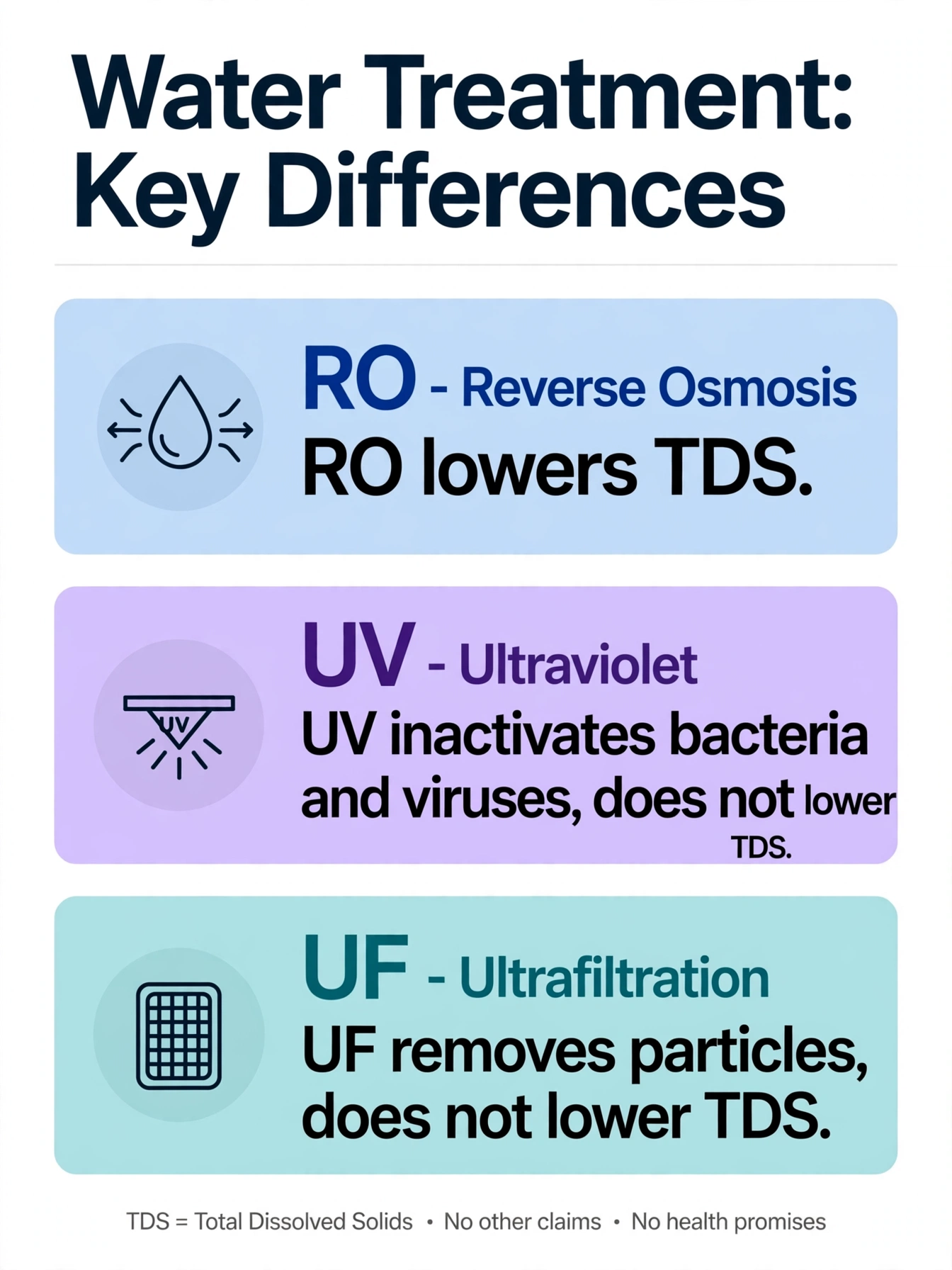
Reverse osmosis, usually called RO, pushes water through a very fine membrane. That membrane can reduce dissolved solids, hardness, and many dissolved contaminants. That is why RO is used for high-TDS water.
RO has trade-offs. It needs electricity and water pressure, it produces reject water, and it also removes some minerals along with the unwanted solids. Many RO models therefore add a TDS controller or mineraliser stage to adjust the final taste and mineral balance. How much reject water is produced, and how the final TDS is set, varies by model. Check the manual for that model, not a general claim.
Ultraviolet
Ultraviolet, usually called UV, uses UV light to inactivate bacteria and viruses. It does not remove dissolved salts, so it does not lower TDS. It does not remove hardness, fluoride, arsenic, or nitrate by itself. UV is useful when your TDS is already acceptable but your water may carry microbes, for example from old municipal pipes or storage tanks.
UV also needs electricity, and its lamp has a limited life. Check the lamp life and replacement cost for the model you are considering.
Ultrafiltration
Ultrafiltration, usually called UF, uses a membrane with larger pores than RO. It can remove suspended particles, turbidity, and many bacteria and cysts, but it does not remove dissolved salts, so TDS stays almost the same after UF. UF often needs less pressure and power than RO, and it is often used together with UV for low-TDS water, or before RO to protect the RO membrane.
In short, UV and UF make water microbe-safer and clearer, but they leave dissolved solids alone. RO is the common home stage that lowers TDS.
RO vs UV vs UF at a glance
| Feature | RO | UV | UF |
|---|---|---|---|
| Lowers TDS | Yes, usually by a large amount | No | No |
| Removes dissolved salts and hardness | Yes, to a large extent | No | No |
| Inactivates or removes microbes | Yes, as part of a full system | Yes, inactivates bacteria and viruses | Removes many bacteria and cysts, check the model |
| Removes particles and cloudiness | Yes, with pre-filters | No, needs a filter stage | Yes |
| Needs electricity | Yes, usually with a pump | Yes | Often no, or low, check the model |
| Produces reject water | Yes, amount varies by model | No | Very little, check the model |
| Best for | High TDS, borewell or tanker water | Low TDS municipal water with microbe risk | Low TDS water that is cloudy or needs particle removal |
Most Indian homes do not buy RO, UV, or UF alone. They buy a combination, such as RO plus UV plus UF, or UV plus UF, with sediment and carbon pre-filters. The combination should follow your water, not the other way round.
Choose by your water source, not by the advertisement
Municipal water
Municipal water in many Indian cities is treated before it reaches your home, but it can pick up contamination from old pipes, intermittent supply, and storage tanks. If your TDS is below 500 mg/L and a lab test does not show a dissolved-contaminant problem, a UV plus UF system with carbon for taste is often enough. You do not need RO just because RO sounds stronger.
If your municipal TDS is above 500 mg/L, or your area is known for hard water, RO becomes more relevant, even for municipal supply.
Borewell water
Borewell water often has high TDS, hardness, and sometimes fluoride, iron, or other dissolved minerals, depending on the area. This is the classic case for RO, usually with UV and UF as well, and with a check on the maximum input TDS the model is rated for. Some models are tested at 750 mg/L, others at 1500 mg/L or more. Do not assume every RO model handles every borewell.
Tanker water
Tanker water is variable. Its source can change, and its quality is not always documented. Treat it like borewell water until you have tested it: check TDS, check for cloudiness and smell, and choose RO if TDS is high. Keep the purifier serviced, because variable input water wears filters faster.
Storage, family size, and power cuts
Storage size is practical, not technical. A small family that uses water mainly for drinking may manage with a 7 to 8 litre tank. A larger family, or a home that also uses purified water for cooking, will need more, and will feel a small tank during a power cut.
Check three things before you decide on size:
- How much purified water your family actually drinks and cooks with in a day.
- How often power cuts happen in your area, because an electric purifier will not refill its tank during a cut.
- How fast the model refills, in litres per hour, as stated in its manual. A slow refill with a small tank is a daily frustration.
Do not choose storage by the largest number on the box alone. Check the usable storage, the refill rate, and whether the tank is easy to clean.
Service, filters, and the real running cost
A water purifier is not a one-time purchase. Filters, membranes, and UV lamps wear out, and service visits cost money and time.
Before buying, check, in writing for that model:
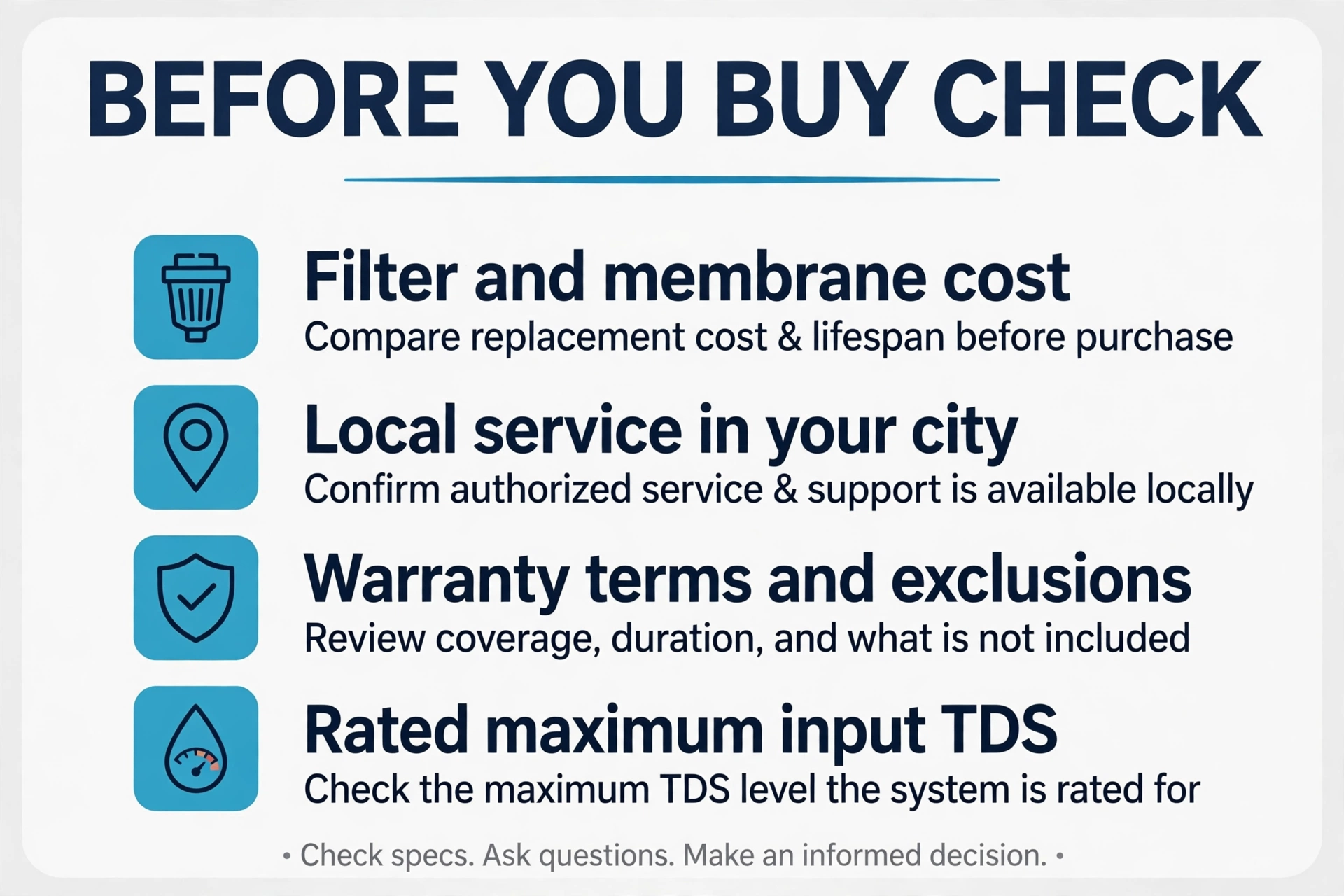
- How often sediment and carbon filters need changing, and what they cost.
- How long the RO membrane is expected to last for your input water, and what a replacement costs.
- How long the UV lamp lasts, and what a replacement costs.
- Whether the maker has service in your city or town, and what an annual maintenance contract covers and excludes.
- What the warranty covers, and for how long. Warranty on the product is not the same as free service, and consumables are often excluded. Check the terms.
A cheaper purifier with expensive filters and no local service can cost more over three years than a slightly dearer model with local service. Ask for the full running cost, not just the purchase price.
Two examples that show how the checklist works
This section is not a ranking, and it is not based on lab testing by BuyinBest. The specifications below are as listed in the models’ manuals and listings, and they are included only to show how to read a specification sheet. Check the current official page and manual for the model you are considering before buying, because specifications and warranty terms change.
| Model, as listed | What it shows | What to check for your home |
|---|---|---|
| Kent Pride Plus, RO plus UF plus TDS control, official Kent page: 8 litre storage, 15 litres per hour, 60 watts, 1 year warranty plus 3 years free service, manual tested on water at 750 mg/L and maximum duty 75 litres per day | A compact RO model for brackish, tap, or municipal water at moderate TDS, with UF after RO | Is your input TDS within its rated range? Is service available in your city? What does its warranty and free service actually cover, and are parts charged separately? |
| Aquaguard Sure Delight 2X UV+UF, official Eureka Forbes page: 6-stage purification, UV e-boiling plus UF 2X, filter life 10000 litres and 2 year filter life as stated, 1 year warranty, works with municipal water only with TDS below 200 ppm, not suitable for borewell or tanker water above 200 ppm | A UV plus UF model that proves the main point of this guide: it is for low-TDS municipal water only, not for high-TDS water | Is your water municipal with TDS below 200 ppm? If not, this model is not for you, however good its filter life looks. What is its storage size for your family, and what does its first-year free service plan cover? |
The lesson from both examples is the same: storage, rated TDS, refill rate, and service matter more than the number of stages printed on the box.
Common mistakes to avoid
- Buying RO for low-TDS water, just because RO sounds best. You pay for reject water, power, and membrane changes you may not need.
- Buying UV or UF for high-TDS water, and then wondering why the water still tastes salty. UV and UF do not lower TDS.
- Ignoring input pressure and temperature. Many RO models are rated for a specific pressure range, for example 0.3 to 4 kg per square centimetre, and a temperature range. Check your home’s pressure before buying.
- Choosing by stage count alone. A 10-stage purifier is not automatically better than a well-matched 5-stage system for your water.
- Forgetting service. A purifier with no local technician is a purifier that will sit unused when a filter fails.
- Using RO reject water without checking guidance for your model. Reject water is not purified drinking water. Use it only for purposes the maker allows, such as cleaning or watering, if at all.
Final advice: a short checklist before you buy
- Test your input TDS, and get a lab test if your source is borewell, tanker, or otherwise doubtful.
- Match the technology to that result: UV plus UF for low TDS with microbe risk, RO for high TDS.
- Check the model’s rated maximum input TDS, storage, refill rate, pressure range, and power use.
- Check filter, membrane, and lamp life and cost, and local service, before you pay.
- Read the warranty terms, especially what is excluded and whether service visits are charged.
- After installation, check the output TDS and taste, and keep the manual for filter-change dates.
If you follow that order, you will buy a purifier for your water, not for an advertisement.
Related guide: How to Choose a Mixer Grinder in India
Frequently asked questions
Do I need RO if my TDS is low?
Usually no, if a lab test does not show a dissolved-contaminant problem. UV plus UF, with carbon for taste, is often enough for low-TDS municipal water. RO is for lowering TDS and dissolved contaminants.
Does UV reduce TDS?
No. UV inactivates bacteria and viruses, but it does not remove dissolved salts, so TDS stays the same.
Does UF reduce TDS?
No. UF removes particles and many microbes, but its pores are too large to remove dissolved salts, so TDS stays almost the same.
Is RO water too pure, with no minerals?
RO does remove minerals along with unwanted solids. That is why many models add a TDS controller or mineraliser stage. Check how the model you are considering sets its final TDS, and do not assume all RO water is the same.
How often will I need service?
It depends on your input water, usage, and model. Sediment and carbon filters are usually changed more often than the membrane, and UV lamps have a fixed operating life. Check the manual for that model, and keep a note of change dates.
What storage size should I choose?
Choose by daily drinking and cooking use, and by power cuts in your area. A tank that is too small will run out during a cut, and a very large tank that is rarely emptied needs cleaning. Check usable storage, not just the headline number.
About the author
This guide was written by Harshal Rathod, who runs BuyinBest.com. The aim is to help Indian households choose a purifier by their own water, not by marketing claims. If you need help with a specific water test result, or you spot an error in this guide, you can reach us through the Contact Us page. For how this site handles privacy, see the Privacy Policy.