
Written by Harshal Rathod | Updated: October 2026
If you cook Indian food every day, your mixer grinder is not a luxury item. It grinds idli and dosa batter, it makes chutney, it grinds dry spices, and it blends. A wrong choice shows up quickly: batter that is not smooth, a jar that leaks, a motor that smells hot after two minutes, or a grinder that stops working just after warranty ends.
Most buyers make the same mistake. They look only at watts, pick the highest number they can afford, and assume that means the best grinder. Watts matter, but they are only one part of the story. A 750-watt grinder with the right jars, a strong motor, and good ventilation can be better for your kitchen than a 1000-watt grinder with poor jars and a weak warranty.
This guide explains, in plain language, how to choose a mixer grinder for Indian cooking: what watts really mean, which jars you actually need, how motor and speed work, what to check in warranty and service, and the common mistakes to avoid. It is written to help you buy once, not to push a specific brand.
We have not lab-tested grinders for this guide. The advice below is based on manufacturer specifications, standard Indian cooking needs, and how these machines are actually used in homes, not on a test we cannot prove.
First, ask what you will grind every day
Before you look at any model, answer this honestly, because it decides almost everything else:
- Do you grind wet batter, like idli and dosa, two or three times a week? Then you need a large wet grinding jar, usually 1.5 litres, with strong blades and a motor that can run for several minutes without overheating.
- Do you mainly make chutney and small quantities? Then a small chutney jar, 0.3 to 0.5 litres, matters more than a huge jar.
- Do you grind dry spices, like garam masala, coffee, or dry chutney powder? Then you need a dry grinding jar with a flat, strong blade, and a lid that seals well, otherwise fine powder escapes.
- Do you have a small family of two or three, or a large family of five or more? A large family needs larger jars and a motor that does not struggle with full loads.
If you buy a grinder with only one large jar, you will struggle with chutney. If you buy a grinder with five jars you never use, you have paid for storage, not for cooking. Most Indian homes do well with three jars: one large wet jar, one medium jar for general use, and one small chutney jar. A fourth dry grinding jar is useful if you grind spices often, but it is not compulsory for everyone.
Watts: what they really mean, and what they do not

Watts tell you how much power the motor draws, not directly how well it grinds. In general:
- 500 watts: enough for light use, chutney, small quantities, and occasional grinding. It may struggle with thick idli batter or large quantities of dry spices.
- 750 watts: the sweet spot for most Indian homes. It handles wet batter, chutney, and dry grinding well, without using excessive power.
- 1000 watts and above: useful for very heavy use, large families, or frequent batter grinding, but it uses more electricity and is often heavier and louder. Higher watts do not automatically mean smoother batter if the jar and blade design are poor.
Think of watts like engine size in a car. A bigger engine can be stronger, but if the rest of the car is weak, it does not help. A well-designed 750-watt grinder with good blades and proper jar shape will often outperform a poorly designed 1000-watt grinder.
Also check the motor type and cooling. A motor with overload protection will cut off if it overheats, which protects the motor but can be annoying if it happens often. That is usually a sign you are overloading the jar or running it beyond its stated duty cycle without a break. Many ordinary models recommend short bursts, for example 30 seconds on, then a short pause, especially for thick batter, but this is not a universal limit. Some models are rated for much longer continuous running. Always follow your model’s stated duty cycle and manual, because running longer than that duty cycle can damage even a good motor.
Jars: size, material, and blades matter more than count
Jars are usually made of stainless steel in India, which is good for durability and cleaning. Check these points, not just how many jars are in the box:
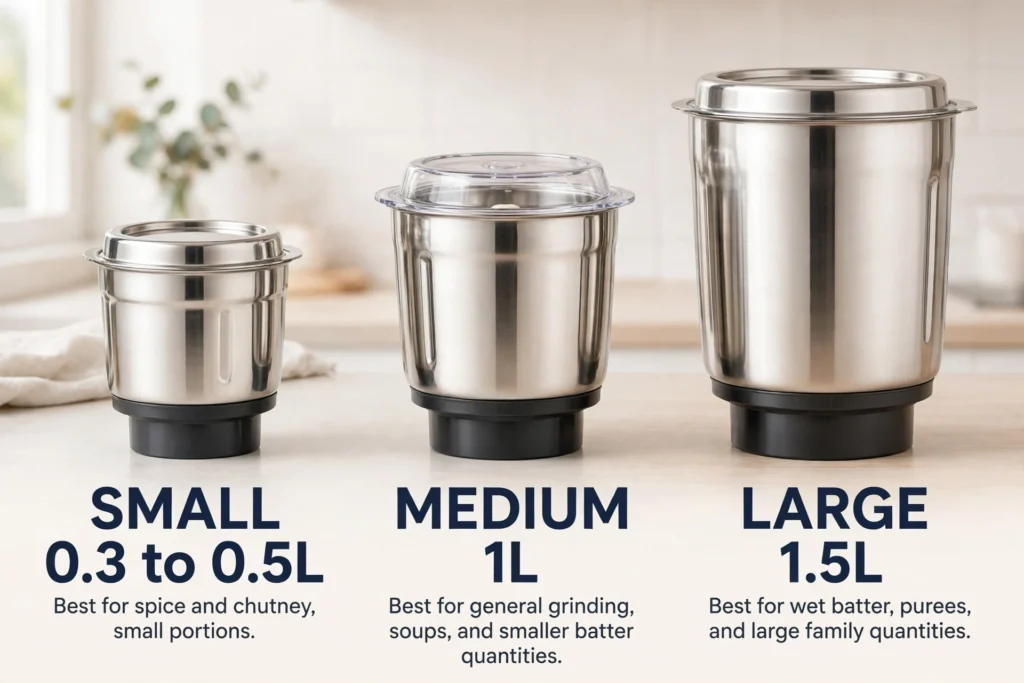
- Wet grinding jar: Usually 1.5 litres for a family grinder. It should have a dome lid that allows batter to circulate, and a handle that stays cool enough to hold.
- Medium jar: Usually 1 litre, for general grinding, soups, and smaller batter quantities.
- Chutney jar: Usually 0.3 to 0.5 litres, with a small blade that can grind small quantities properly. A large jar cannot grind a small chutney well, because the ingredients do not reach the blade.
- Dry grinding jar: Usually 0.5 to 1 litre, with a flat blade for spices. If you grind spices in a wet jar, you will get uneven powder and a lid that does not seal well.
Blade quality matters. Look for stainless steel blades that are fixed firmly, not loose, and check if replacement blades are available in your city. A grinder with a great motor but a blunt or loose blade will disappoint you within months.
Lid and gasket are small parts that cause big problems. A lid that does not seal will leak batter, especially at high speed. A gasket that wears out quickly will need replacement. Check if spare lids and gaskets are sold by the brand, because that is a practical sign of good service.
Speed settings and controls
Most mixer grinders in India have three speeds, plus a pulse or inching button. Three speeds are enough for most homes:
- Low speed: for soft items, mixing, and starting a grind slowly
- Medium speed: for general grinding
- High speed: for thick batter and dry spices, in short bursts
Pulse is useful for chutney, because you can control texture. You do not need five or six speeds for normal cooking. More speeds often mean more confusion, not better food. What matters more is that the speed dial is firm, does not slip, and the grinder does not vibrate excessively at high speed. Excessive vibration usually means the jar is not seated properly, or the grinder feet are worn.
Motor, noise, and safety: what to actually check
Noise is normal for a mixer grinder, especially at high speed, but a grinder that rattles, moves across the counter, or smells of burning after one minute is a warning sign. Check:
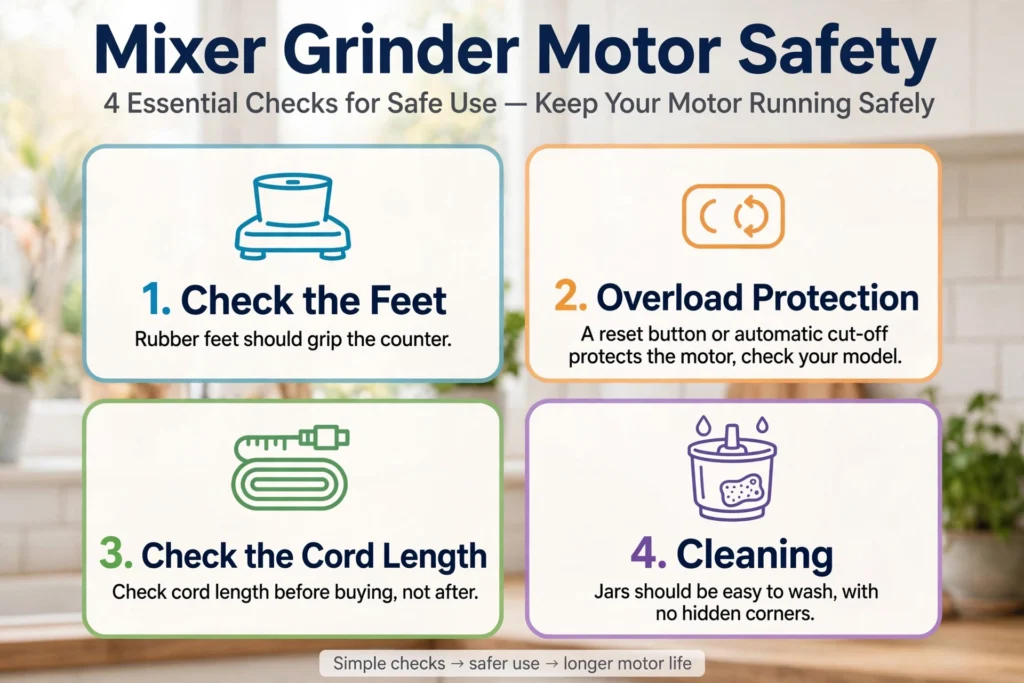
- Feet and base: Rubber feet should grip the counter. If the grinder walks across the counter, it is unsafe, especially with hot liquids.
- Overload protection: A reset button or automatic cut-off protects the motor. Learn where it is, before you need it.
- Cord length and storage: In Indian kitchens, the plug point is often far from the counter. A short cord is a daily annoyance. Check cord length before buying, not after.
- Cleaning: Jars should be easy to wash, with no hidden corners where batter dries. A grinder that is hard to clean will be used less, no matter how powerful it is.
Copper vs aluminium motor: which should you pick?
When checking motor specifications, look for 100% copper winding if it is listed on the spec sheet. Copper is widely used for motor windings because it handles heat well, which matters if you grind tough ingredients like soaked urad dal or turmeric. Aluminium-wound motors can keep a grinder lighter and cheaper, but check the spec sheet and warranty carefully, because winding material alone does not guarantee a longer life.
What about RPM (rotations per minute)?
Many Indian mixer grinders list speeds around 18,000 to 22,000 RPM at no load. A medium speed is often better for wet batter, because very high speed can generate friction heat. A higher speed is often useful for fine dry spice powders. RPM alone does not decide grinding quality, jar shape, blade design, and load matter as well, so use RPM as one check among others, not as the only number. Sujata Dynamix specifications
For safety, never put your hand in a jar while it is on the base, and never run a jar without its lid.
For hot ingredients, follow your jar’s temperature restriction in the manual. Cool ingredients as the manual says, do not pour boiling liquid into a jar that is not rated for it, and check the lid and steam vent instructions for your exact model, because a lower speed alone does not make hot ingredients safe.
Comparison: which type suits which home?
| Home type | Best watts range | Jars to prioritise | Why |
|---|---|---|---|
| Small family, light use, mainly chutney | 500-750 W | Small chutney + medium jar | Lower cost, enough power, easy storage |
| Normal family, daily Indian cooking | 750 W | Wet 1.5 L + medium + chutney | Balanced power, batter, and chutney in one machine |
| Large family, frequent batter | 750-1000 W | Large wet jar + dry jar | Handles full loads, less overheating, better for batter |
| Spice grinding often, small quantities | 750 W | Dry jar + chutney jar | Dry blade and small jar give even powder |
This table is a starting point, not a rule. If you cook only occasionally, a 500-watt grinder may be enough and will save money and counter space. If you run a small food business from home, you may need a commercial grinder, not a home mixer grinder at all, and that is a different purchase.
Warranty and service: read this before you pay
Warranty is where many buyers lose money. Check, in writing, on the product page or in the manual:
- How many years are covered for the motor, and how many for the whole product? They are often different. A 5-year motor warranty with only 1 year for other parts is common.
- What is not covered? Overloading, water damage to the motor, and using the wrong jar are often excluded.
- Where is service available? A brand with a service centre in your city is worth more than a slightly cheaper brand with no local service.
- Are spare parts, like blades, lids, and gaskets, available separately? If not, a small broken part can mean replacing the whole grinder.
Keep your bill and warranty card, and register the product if the brand asks you to. Without a bill, warranty claims are often rejected, even if the product is genuinely faulty.
Common mistakes to avoid

- Buying only by watts, without checking jars and blades.
- Buying a grinder with too many jars you will never use, just because the box looks like value.
- Overfilling a jar. Fill only to the level recommended in your model’s manual, not to the brim, otherwise batter will leak and the motor will strain.
- Running longer than your model’s stated duty cycle without a pause, especially for thick batter. Short bursts are better for many ordinary models, but some models are rated for longer runs, so check your model’s manual.
- Grinding very hot liquids at full speed without checking the manual.
- Ignoring cord length, counter space, and cleaning, which affect daily use more than a small watt difference.
Two models that show how the checklist works
The two examples below are not a ranking and were not lab-tested by us. They show how the same checklist, watts, jars, duty cycle, and warranty, gives a different answer for different homes. All specifications are manufacturer-stated, check the linked official page and manual for your exact model before buying, because specifications can change.
| Model | Manufacturer-stated power and jars | Manufacturer-stated duty and warranty | What it shows |
|---|---|---|---|
| Sujata Dynamix 900W | 900W, 100 percent copper winding, double ball bearings, jars 1500 ml dome, 1000 ml dry, 500 ml chutney, 3 speeds plus whipper | Rating 90 minutes, no-load speed about 22000 RPM, 2-year product warranty, spare parts and doorstep service stated by the manufacturer | Heavy-duty use, long continuous runs, and a larger wet jar suit frequent batter grinding, but it is more than most small homes need. |
| Preethi Aries 750W | 750W, 4 jars including a 0.2 litre turbo mini spice jar, stainless steel jars, 3 speeds plus incher, overload protector | Manufacturer states it can continuously grind urad dal for 30 minutes, 5-year motor warranty, 2-year product guarantee, lifelong free service stated by the manufacturer, check the terms | Normal daily Indian cooking, wet batter in a 1.5 litre or 1.0 litre jar, dry grinding in a 1.0 litre or 0.5 litre jar, and small chutney in a 0.5 litre jar, without paying for heavy-duty capacity. |
How to read this table: do not pick by watts alone. Match the jar sizes to what you actually grind, match the duty cycle to how long you actually run the machine, and match the warranty split, motor years versus product years, to what is written in the manual, not to a headline claim. If a specification is missing from an official page, treat that as a gap to check with the brand, not as a reason to assume it.
Frequently asked questions
Is 750 watts enough for idli batter?
For most homes, yes, if the wet jar is 1.5 litres and you run in short bursts with pauses, as the manual recommends. For very large quantities, or for daily commercial use, a higher wattage or a dedicated wet grinder may be better.
Can I grind dry spices in the same jar as wet batter?
You can, but the result is often uneven. A dedicated dry jar gives finer, more even powder and keeps flavours from mixing. If you grind spices only occasionally, a medium jar is acceptable, but clean and dry it fully first.
Why does my mixer grinder stop suddenly? Most often, overload protection has cut in because the jar was too full, the load was too thick, or it ran beyond its stated duty cycle without a pause. Let it cool, reduce the load, press the reset button if your model has one, and try again in short bursts. If it happens often with normal loads, contact service, do not keep forcing it.
How long should a good mixer grinder last?
With normal home use and proper cleaning, a good grinder often lasts 5 to 8 years or more, with blade or gasket replacement in between. Heavy daily batter grinding will wear it faster. Warranty years are not the same as expected life, they are the minimum the brand promises to cover.
Should I buy a grinder with a juicer attachment?
Only if you will actually juice regularly. A juicer attachment adds cost, storage, and cleaning, and many buyers use it a few times and then leave it in a cupboard. Buy it as a separate juicer if juicing is a daily habit, otherwise skip it.
Why does a new mixer grinder smell like burning on the first use?
A slight burning smell during the first 2 to 3 runs is common. Manufacturers coat motor windings in an insulating varnish that heats up when first used, and the smell usually disappears after a few short runs. If it continues, or if there is smoke, turn it off immediately and contact service, do not keep using it.
Can I run a mixer grinder continuously for 5 to 10 minutes?
Operating time depends on the specific model, the ingredients, the quantity, and the manufacturer’s duty cycle, including any required cooling breaks. Some models, for example Sujata Dynamix, are stated by the manufacturer to run continuously for up to 90 minutes, while many ordinary models require short bursts with pauses. Do not assume one limit covers every grinder, always check the manual for your exact model before running it for several minutes at a time. Sujata Dynamix official specifications Preethi Aries official page
Final advice
Do not buy a mixer grinder by watts alone, and do not buy by the number of jars in the box alone. Buy by what you cook every day.
For most Indian homes, a 750-watt grinder with three useful jars, a large wet jar, a medium jar, and a small chutney jar, with a strong motor, good blades, overload protection, and service in your city, is the safest choice. Check the exact jar sizes, warranty for motor versus whole product, and cord length before you pay, and keep your bill.
If you cook for a large family or grind batter every day, step up to a higher wattage and a larger wet jar, but still check the same points. The best grinder for you is the one you will actually use every day, clean easily, and get serviced locally, not the one with the biggest number on the box.
About the author
Harshal Rathod runs BuyinBest.com, which writes buying guides for everyday products in India, focusing on how products are actually used in Indian homes. This guide is based on manufacturer specifications, standard Indian cooking needs, and how these machines are actually used in homes, not on lab testing claims that cannot be proved. You can reach Harshal through the Contact Us page.