
Written by Harshal Rathod | Updated: October 2026
A power bank is one of the easiest accessories to buy badly, because the biggest number on the box is not the number you actually get. This guide explains how to choose a power bank in India by real capacity, charging speed, ports, refill time and safety, so you can judge any model yourself instead of trusting the headline figure.
Start with the habit that matters most. A power bank is useful only if it is charged, carried, and compatible with your phone. A very large, heavy power bank that stays at home because it is too bulky to carry will not help you on a train, in a college, or during a power cut. A small, light power bank that cannot finish one full phone charge will disappoint you in a different way. The right size is the one that matches how many charges you need, how fast you need them, and how much weight you are willing to carry every day.
Capacity: mAh is not the charge you get
Power bank makers quote capacity at the voltage of the internal battery cells, usually about 3.7 volts. Your phone charges at 5 volts or more, and converting between those voltages loses energy as heat. Cables, the phone’s own charging circuit, and the power bank’s safety cut-offs lose a little more.
A simple way to compare models is to convert the headline figure into watt-hours, which is stored energy:
Wh = (mAh ÷ 1,000) × 3.7
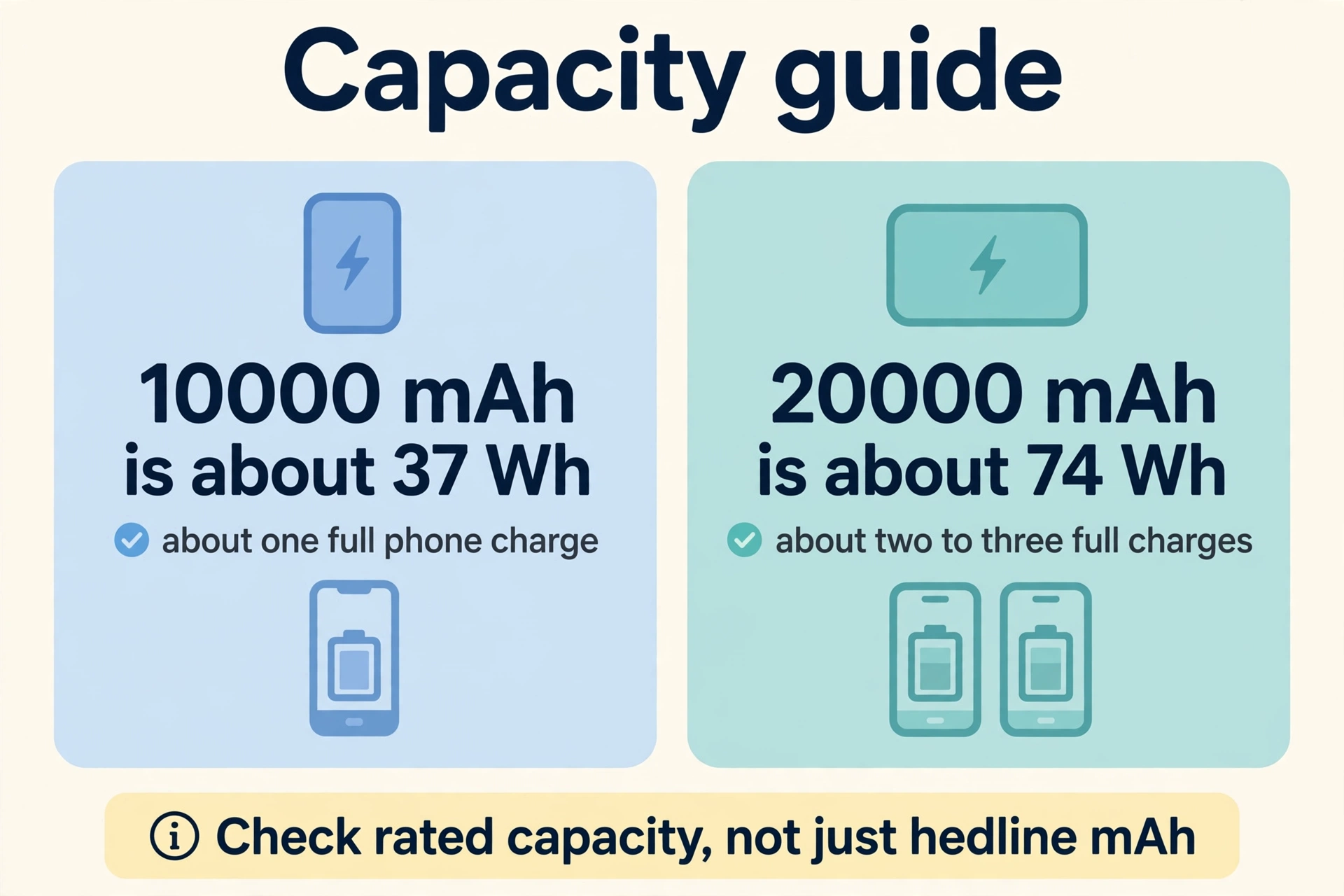
So a 10,000mAh power bank stores about 37Wh, and a 20,000mAh power bank stores about 74Wh. That is the energy inside the cells, before conversion losses. In real use, plan on roughly two-thirds to three-quarters of that energy reaching your phone, depending on the model, the cable, and how fast you charge.
Worked out for a phone with a roughly 5,000mAh battery, which is common in India now:
- A 10,000mAh power bank gives about one full charge, plus a useful partial charge. It does not give two full charges, even though the numbers look as if it should.
- A 20,000mAh power bank gives about two to three full charges, depending on the phone and on losses. It does not give four full charges.
Also check the rated capacity, not just the headline capacity. Some makers print a second, smaller figure, such as the capacity delivered at 5 volts. That smaller figure is closer to what your phone receives. If a listing promises that a 10,000mAh power bank will charge your phone five times, the maths does not work, and that listing should not be trusted.
How much capacity do you actually need
Do not buy capacity for its own sake. Buy it for the charges you need between two chances to plug in.
- For daily pocket carry, one phone, and a short commute, 10,000mAh is usually enough. It covers one full charge and a top-up, and it stays light enough for a pocket or a small sling bag.
- For a long workday, a phone plus earbuds, hotspot use, or a family sharing one power bank, 20,000mAh is the usual middle ground. It is heavier and needs a bag, but it removes the worry of running out.
- For a weekend trip, two phones, a tablet, or a place with unreliable power, 20,000mAh to 27,000mAh makes sense. Above about 27,000mAh, check airline rules carefully, because most airlines limit a single battery to 100Wh in cabin baggage, and 27,000mAh at 3.7 volts is already about 100Wh. Spare batteries belong in cabin baggage, not checked baggage, and your airline’s rules are the final word.
Weight is part of this decision, not a footnote. A 10,000mAh model is often around 280 grams. A 20,000mAh model is often around 400 grams or more. That difference matters if you carry it in a pocket every day, and matters much less if it lives in a backpack.
Wattage and protocols: speed is a system, not a single number
Wattage tells you how fast power can move. A higher wattage power bank does not automatically fast-charge your phone. Your phone, your cable, and the charging protocol must all support that speed. If any one of them is slower, the slowest part sets the speed.
The protocols you will see most often are USB Power Delivery, usually written as PD, and Qualcomm Quick Charge, usually written as QC. Newer models may also list PPS, which lets the charger adjust voltage more finely. For most Android phones, PD is the useful standard to look for. For iPhones, a USB-C PD power bank is also the normal route. A power bank that supports only an older, brand-specific fast charge may charge other brands’ phones slowly, even if its headline wattage looks high.
For most Indian buyers, these ranges are a useful starting point:
- Around 18 to 22.5 watts suits most phones for everyday fast charging, and it is the normal range for good 10,000mAh and 20,000mAh pocket models.
- Around 30 watts is useful if your phone supports it, or if you also charge a small tablet. It will not help a phone that only accepts 18 watts.
- Around 45 to 67 watts is useful only if you charge a tablet, a handheld gaming device, or a USB-C laptop, or if you want the power bank itself to refill quickly. For a phone alone, it is more than you need, and it usually means a heavier, dearer model.
Also check what happens when you charge two or three devices at once. The headline wattage is usually for one port alone. When all ports are in use, the total power is shared, and each device charges more slowly. A model that clearly states its dual-port and triple-port output is more honest than one that only prints the single-port maximum.
Refill time: the power bank must charge too
A power bank that takes all night to refill will be empty when you need it next. Refill time depends on the power bank’s input wattage and on the wall charger you use. A 20,000mAh power bank with only 10 watt input will take many hours, even with a good cable. The same capacity with 18 to 22.5 watt input, or with 65 watt input on a high-wattage model, refills much faster, provided you use a compatible wall charger.
Check two things before you buy. First, the input wattage and port, usually USB-C on current models. Second, whether a wall charger is included in the box. Many current power banks do not include one, so you may need to use a charger you already own, and a slow charger will make even a good power bank refill slowly. Plan the charger as part of the purchase, not as an afterthought.
Ports, cables and small-device charging
Count the ports you will actually use, not the ports on the box. One USB-C port and one or two USB-A ports cover most Indian households, because older cables, earbuds cases, and second phones still use USB-A, while current phones use USB-C.
A built-in cable is genuinely useful. It means you cannot forget the cable, and it doubles as a carrying loop on some models. The trade-off is that a built-in cable cannot be replaced easily if it wears out, and it only helps if it matches your phone’s port. If your household has both USB-C and older phones, a separate cable may be more flexible than a built-in one.
Small devices need a different mode. Earbuds, fitness bands, and smartwatches draw very little current, and some power banks switch off because they think nothing is connected. A low-current or low-power mode, often switched on by pressing the power button twice, keeps the power bank on for these devices. If you charge earbuds or a band from your power bank often, check that your exact model has this mode, and how to switch it on, before you buy.
Safety in India: BIS, heat and fakes
A power bank stores a lot of energy in a small case, so safety is not a marketing extra. In India, power banks sold through proper channels should carry BIS certification under the Compulsory Registration Scheme. BIS certification is a safety floor, not a guarantee of capacity or speed. It means the model passed a minimum safety test, not that its headline capacity is accurate.
Practical checks that matter more than a logo on a listing photo:
- Buy from the brand’s own store or a reputable retailer, not from a random listing with a very low price for a very high capacity. If a 20,000mAh power bank costs a fraction of the normal range, it is very likely not a 20,000mAh power bank.
- Check the BIS registration details on the packaging and on the product itself, and check that they match the brand and model you are buying. A copied BIS number on a fake product is a known problem, so a number alone is not enough.
- Stop using a power bank at once if it swells, gets excessively hot, smells unusual, or is damaged. Do not charge it, do not put it in water to cool it, and do not keep it in a closed, hot place such as a car dashboard in summer.
- Keep a power bank away from water, direct sunlight, and high heat, and follow your model’s manual on operating temperature. Most current models are designed for normal room temperatures, not for extreme heat.
A cheap, uncertified power bank can damage your phone, and in the worst case it can be a fire risk in a bag or in luggage. Saving a small amount on a power bank is not worth that risk.
Three models that show how the checklist works
This section is not a ranking, and it is not based on lab testing by BuyinBest. The specifications below are as stated by the makers and in their manuals and listings, and they are included only to show how to read a specification sheet. Check the current official page and manual for the model you are considering before buying, because specifications and warranty terms change.
| Model, as listed | What it shows | What to check for your home |
|---|---|---|
| Xiaomi Power Bank 4i 10000mAh, official Xiaomi India: 10,000mAh, 37Wh, up to 22.5W single-port output, 18W with two ports, 15W with three ports, 22.5W USB-C input, 1 USB-C port and 2 USB-A ports, low-current mode, 12-layer protection, 280 grams, 14.78 × 7.39 × 1.53 cm, 1 year manufacturer warranty as in its manual | A light, everyday pocket model that shows the honest trade-off: full speed only on one port, slower when all three ports are used | Is one full phone charge plus a top-up enough for your day? Do you need low-current mode for earbuds or a band? Is 280 grams light enough for your pocket? |
| Ambrane Stylo 20, official Ambrane India: 20,000mAh, up to 22.5W output, triple output with 2 USB-A ports and 1 Type-C port, Quick Charge 3.0 and Power Delivery, multi-layer chipset protection, Made in India, BIS validated as stated by Ambrane, 180 days warranty | A larger, Indian-brand travel model that shows the capacity jump, and also the warranty trade-off: 180 days is much shorter than the 1 year warranty on the Xiaomi models above | Is 20,000mAh worth the extra weight and bag space for you? Is 180 days warranty enough, and is service available in your city? Do you need three ports at once? |
| Xiaomi Power Bank 5i 20000mAh 67W, official Xiaomi India: 20,000mAh, rated capacity 12,000mAh at 5V, 74.37Wh, under 100Wh, up to 67W output, up to 65W input, built-in USB-C cable plus a USB-C port and a USB-A port, digital display, PD 3.0 with PPS and QC 3.5, 12-layer protection | A high-wattage travel model that shows why wattage alone is not the whole story: it can charge a tablet or a USB-C laptop, and it refills itself fast, but it is heavier and more than a phone alone needs | Do you charge a tablet or laptop on the go, or only a phone? Is the built-in cable a benefit, or do you need a replaceable cable? Is the extra weight and size worth it for your bag? |
Why these three, and why not others you may recognise? They show three different trade-offs, not three versions of the same model: a light 10,000mAh pocket model, a 20,000mAh Indian-brand model with a short warranty, and a 20,000mAh high-wattage model with a built-in cable and a display. That is the point of the section.
One model worth acknowledging is the Anker Nano Power Bank 10000mAh, with a built-in USB-C cable and up to 30W output. It is a good pocket alternative, but it is in the same 10,000mAh class as the Xiaomi 4i, and the built-in cable lesson is already shown by the Xiaomi 5i above, so it does not add a new lesson to this checklist. If you prefer Anker, judge it on the same checklist: real capacity, single-port wattage, refill input, low-current mode, warranty, and service in India for your exact variant.
The research lesson here is also why recognisability alone was not the test. Xiaomi is a familiar brand, yet the Ambrane model above is included even though it is less familiar to some buyers, because it shows a real 20,000mAh option with a different warranty and service picture. A familiar name that fails on warranty, refill time, or service for your use should not be chosen just because it is familiar, and a less familiar name should not be excluded just because it is less familiar.
Pros and cons, in brief
Xiaomi Power Bank 4i 10000mAh: light, simple, and fast enough for most phones on one port, with low-current mode for small devices. The trade-off is capacity: about one full phone charge, not two, and slower output when all three ports are used.
Ambrane Stylo 20: larger capacity for trips and shared use, with three ports and Indian-brand service claims to check in your city. The trade-off is weight, bag space, and a much shorter 180 days warranty than the Xiaomi models above.
Xiaomi Power Bank 5i 20000mAh 67W: fastest output and fastest refill of the three, with a built-in cable and a digital display, and useful for a tablet or USB-C laptop. The trade-off is size and weight, and more power than a phone alone needs.
Common mistakes to avoid
- Buying the biggest mAh number without checking watt-hours, rated capacity, and weight. A 20,000mAh model you leave at home helps no one.
- Assuming a 10,000mAh power bank gives two full phone charges. In real use, plan on about one full charge plus a top-up.
- Assuming a high wattage number means fast charging for your phone. Your phone, cable, and protocol must support that speed.
- Charging three devices at once and expecting full speed on each. Total power is shared, so each device charges more slowly.
- Forgetting refill time. A power bank with slow input will be empty when you need it, even if its output looks good.
- Buying a very cheap, uncertified power bank from a random listing. Check BIS details, brand, and model, and buy from a reputable seller.
- Using a power bank for earbuds or a band without low-current mode, and wondering why it switches off.
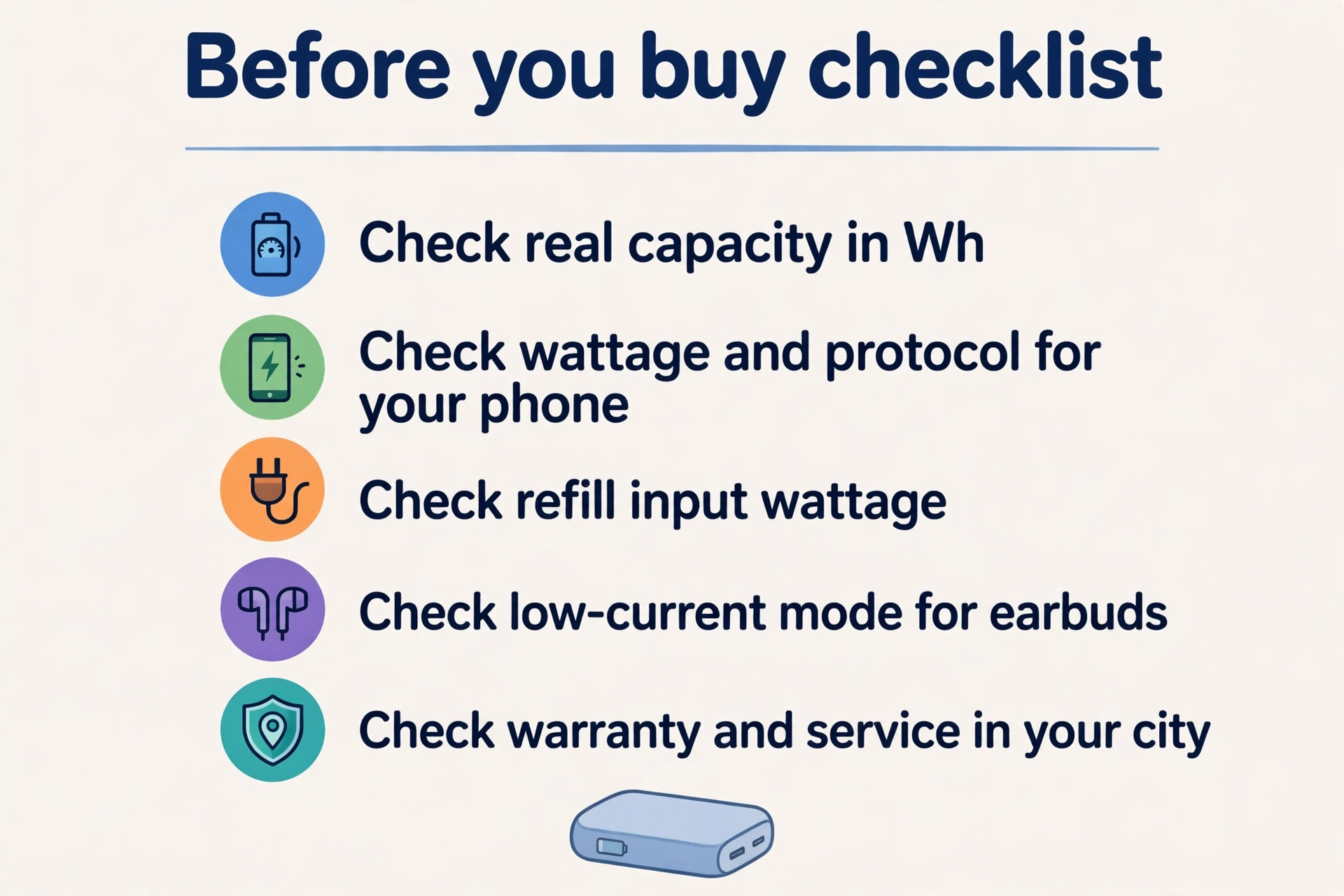
Final checklist before you buy
- Count the charges you need between two plug-in chances, not the biggest number on the box.
- Convert mAh to watt-hours, and check the rated capacity at 5 volts if the maker prints it.
- Match wattage and protocol to your phone. PD is the usual useful standard for current phones.
- Check input wattage and refill time, and whether a wall charger is included.
- Count the ports and cables you will actually use, and check low-current mode if you charge earbuds or a band.
- Check BIS details, warranty length, what it covers, and service in your city for your exact variant.
- Check weight and size against how you will carry it, pocket or bag, and check airline rules if you fly with a large model.
- Check the current price, warranty card, and manual for the exact variant before you pay, because listings change.
If you follow that order, you will buy a power bank for your phone, your bag, and your day, not for a headline number alone.
Frequently asked questions
How many times will a 10,000mAh power bank charge my phone?
For a phone with a roughly 5,000mAh battery, plan on about one full charge plus a useful partial charge, not two full charges. Conversion losses, cables, and the phone’s own charging circuit use part of the stored energy.
How many times will a 20,000mAh power bank charge my phone?
For the same roughly 5,000mAh phone, plan on about two to three full charges, depending on the model and on losses. It will not give four full charges, even though the headline numbers suggest it might.
Is a higher wattage power bank always faster?
No. Your phone, cable, and charging protocol must support that wattage. If your phone only accepts 18 watts, a 67 watt power bank will not charge it at 67 watts. Match wattage to your phone, not to the box.
Why does my power bank switch off when charging earbuds?
Earbuds and bands draw very little current, and some power banks switch off because they think nothing is connected. Use low-current mode if your model has it, usually by pressing the power button twice, and check your model’s manual for how to switch it on.
Can I carry a power bank on a flight?
Most airlines allow power banks up to 100Wh in cabin baggage, and not in checked baggage, but your airline’s rules are final. A 20,000mAh model at 3.7 volts is about 74Wh, and a 27,000mAh model is about 100Wh, so check the watt-hour rating printed on your exact model before you fly.
Do I need a separate wall charger for a power bank?
Often, yes. Many current power banks do not include a wall charger in the box. Check the box contents, and use a charger that matches the power bank’s input wattage, otherwise refill time will be much longer than the listing suggests.
About the author
This guide was written by Harshal Rathod, who runs BuyinBest.com. The aim is to help Indian households choose a power bank by their own phone, bag, and daily use, not by marketing claims. If you need help with a specific model, or you spot an error in this guide, you can reach us through the Contact Us page. For how this site handles privacy, see the Privacy Policy.